|
Welcome to your first CES edition of TMA, attempting (almost futilely) to distill the biggest product reveals and announcements. Despite two days of briefings and conferences, today is merely day one. However, we've already seen Sony Honda reveal its next car — and the Afeela 1 isn't yet on sale. We've got a deep dive on what we've seen so far, right here.
AMD announced new Ryzen AI 400 laptop processors and updated desktop chips, including the Ryzen 7 9850X3D, with a new focus broadly on AI processing improvements. NVIDIA had a lengthy, dense press conference showing off its dominance in AI tech, but it lacked major consumer announcements — until overnight, when it revealed next-gen G-Sync tech and an upgraded version of DLSS. The new tech can handle up to 4K 240Hz path traced performance. It also adds an improved version of Super Resolution Transformer, with more stability.
This year's wildcard CES press conference was… Lego? It revealed Smart Bricks, which adds sensors, audio and wireless communication to traditional Lego pieces. The system is launching with Star Wars sets later this year — and perhaps crucially, no smartphone or screen is needed to play.
There's also LG and Samsung to get into — more on those below!
— Mat Smith
The other big stories (an
|
|
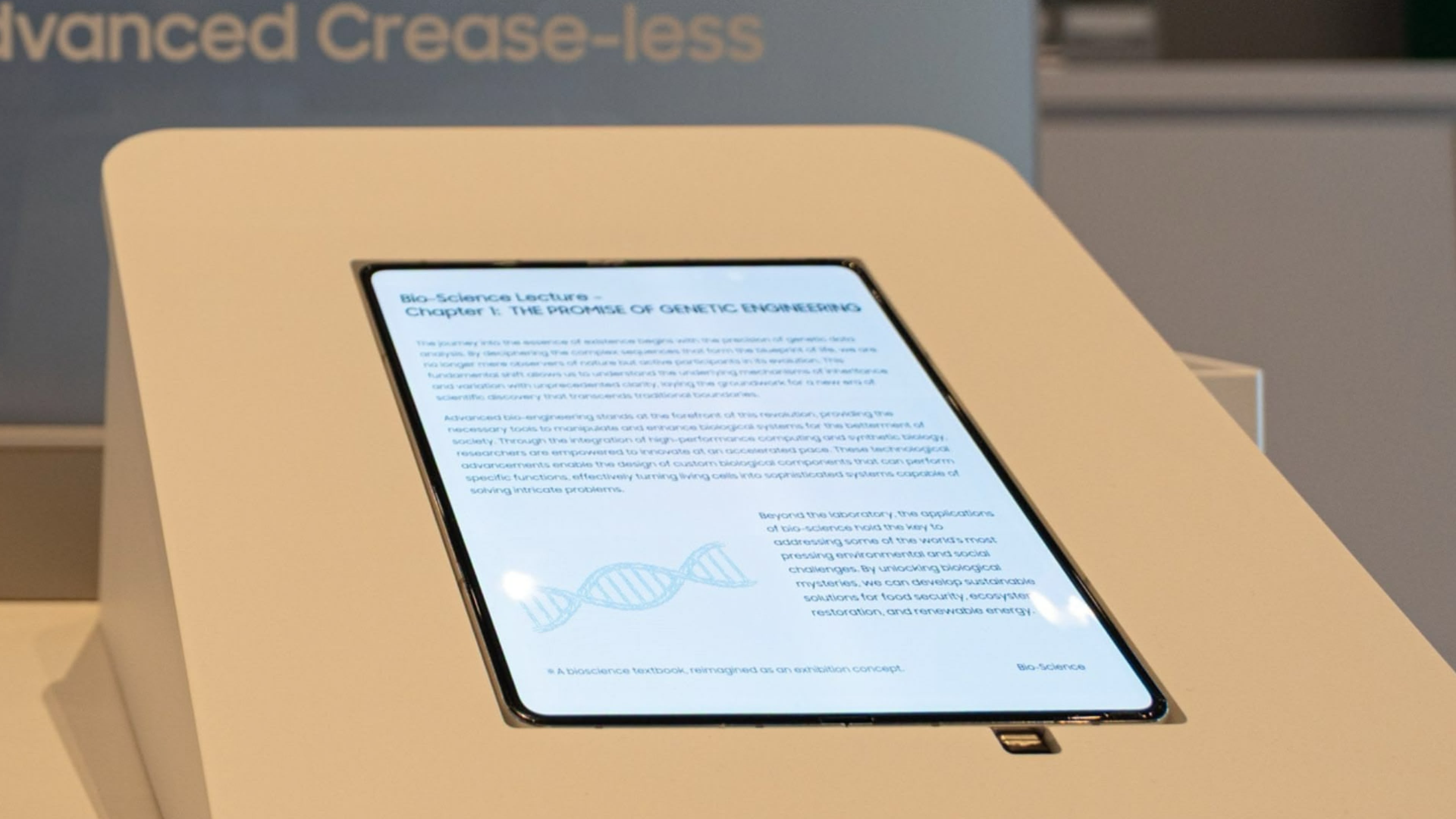 CES 2026 has just provided a first glimpse of the folding display technology that Apple is expected to use in its upcoming foldable iPhone. At the event, Samsung Display briefly showcased its new crease-less foldable OLED panel beside a Galaxy Z Fold 7, and according to SamMobile, which saw the test booth before it was abruptly removed, the new panel "has no crease at all" in comparison. CES 2026 has just provided a first glimpse of the folding display technology that Apple is expected to use in its upcoming foldable iPhone. At the event, Samsung Display briefly showcased its new crease-less foldable OLED panel beside a Galaxy Z Fold 7, and according to SamMobile, which saw the test booth before it was abruptly removed, the new panel "has no crease at all" in comparison.
|
|
Owen Poole covers the biggest news from CES, including the public debut of the production model of the Atlas Robot, Samsung's big announcements, including a really big TV and a really big phone, and new information on 'the most luxurious robo-taxi.'
|
|
When I first heard whispers about the Samsung Galaxy Z TriFold, I immediately felt conflicted. On one hand it felt like the natural evolution of bi-fold phones like the Z Fold 7. But on the other, all this fancy tech comes with an even higher price — around $2,500 based on current conversion rates from Korean won — not to mention the added bulk you get from a third folding panel. So even as someone who has used a foldable as my daily driver for almost a decade straight, it felt like Samsung's latest high-end phone was going backwards in terms of both portability and affordability. But then at CES 2026, I got a chance to go hands-on with the Galaxy Z TriFold and all of my concerns pretty much instantly disappeared because with this thing, flexing is believing.
My initial consternation comes in large part from using the Z Fold 7, which hit a major milestone this year thanks to a revamped design that doesn't come with any added size or weight even when compared to comparable candybar-style phones like the Galaxy S25 Ultra. That's a major breakthrough considering how hefty and chunky the
|
|